The Core of Inert Gas Protection: Beyond Purity — It’s About Pressure and Continuity
获取链接
Facebook
X
Pinterest
电子邮件
其他应用
In most industrial processes, inert gases such as nitrogen play a critical role in establishing a stable “safe environment.” Their effectiveness relies on three fundamental pillars: appropriate gas purity, constant positive pressure, and unbroken supply continuity. In practice, the latter two — pressure and continuity — are often overlooked yet are the most fatal weaknesses.
I. Why Pressure Fluctuations Deserve More Attention Than Purity
In inert gas protection systems, purity is often treated as the top priority. However, in most incidents and failures, the real trigger is not insufficient purity but unstable pressure. When pressure suddenly drops, outside air can flow back into the system, causing the oxygen concentration to rise sharply within seconds. Even if purity technically meets specifications, it can no longer prevent unwanted reactions or oxidation.
Take a storage tank nitrogen-blanketing system as an example. Its safe operation heavily depends on the continuity of nitrogen protection. When internal pressure drops below the set limit due to discharge or cooling, the breather valve opens to replenish gas. If nitrogen supply is delayed or interrupted at this moment, ambient air will be drawn into the tank, forming an explosive mixture with volatile materials. Once such a mixture encounters static electricity or sparks, flash explosions or fires can occur, leading to severe accidents.
II. How Pressure Fluctuations Destroy the Inert Environment
The damage caused by pressure fluctuations is a rapid, chain-reaction process. The danger lies not only in the initial air intrusion but also in the subsequent cascade of uncontrollable consequences.
In summary, pressure fluctuations first destroy the system’s physical integrity instantaneously, then cause a dual collapse of safety and production continuity. Compared with purity variations, pressure instability challenges the very foundation of the inert protection system.
1. Initial Breakdown: Instant Loss of the Protective Barrier
When the system pressure drops sharply, forming negative pressure, the immediate result is the reverse breakdown of the physical isolation barrier. Outside air enters through breather valves or other openings. Even if nitrogen purity remains within standard, this single “breathing event” irreversibly contaminates the protected space, sharply increasing oxygen levels.
2. Escalating Consequences: From Local Contamination to Systemic Risk
Transformation of Safety Risk: In flammable or explosive environments, a single air ingress can instantly create a locally explosive atmosphere, putting the entire system at immediate risk. This is no longer a gradual risk of “insufficient purity,” but an instantaneous and severe failure of the inert environment.
Triggered Production Shutdowns: A sudden pressure drop is often detected by sensitive safety interlock systems (SIS) or distributed control systems (DCS), which may automatically classify it as a critical fault — triggering chain shutdowns of the entire unit or related subsystems, resulting in unplanned downtime.
In summary, pressure fluctuations first destroy the system’s physical integrity instantaneously, then cause a dual collapse of safety and production continuity. Compared with purity variations, pressure instability challenges the very foundation of the inert protection system.
III. Key Capabilities of a Reliable Inert Gas Protection System
The reliability of an inert protection system is not determined solely by maximum gas output or nominal purity, but by whether it can maintain continuous supply when pressure fluctuations occur. An ideal system should meet the following criteria:
Buffer Capacity: The system can maintain pressure through gas storage or rapid response when gas demand suddenly increases.
Redundant Pathways: Backup units can seamlessly take over during maintenance or failure of the main unit.
Automatic Regulation: The system can automatically adjust flow according to real-time pressure changes, avoiding overshoot or lag.
If any of these elements are missing, even the highest purity cannot ensure stable and reliable inert protection.
IV. How to Build a Reliable Inert Gas Protection System
Whether it’s a heat treatment furnace, a chemical storage tank with nitrogen blanketing, or a powder conveying and coating process, risks often arise from pressure fluctuations, gas supply interruptions, or oxygen content loss of control.
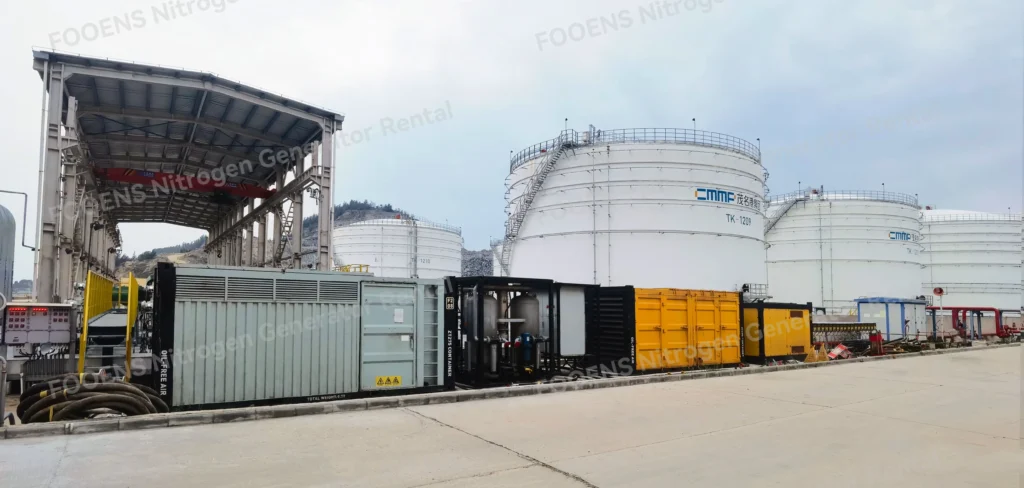
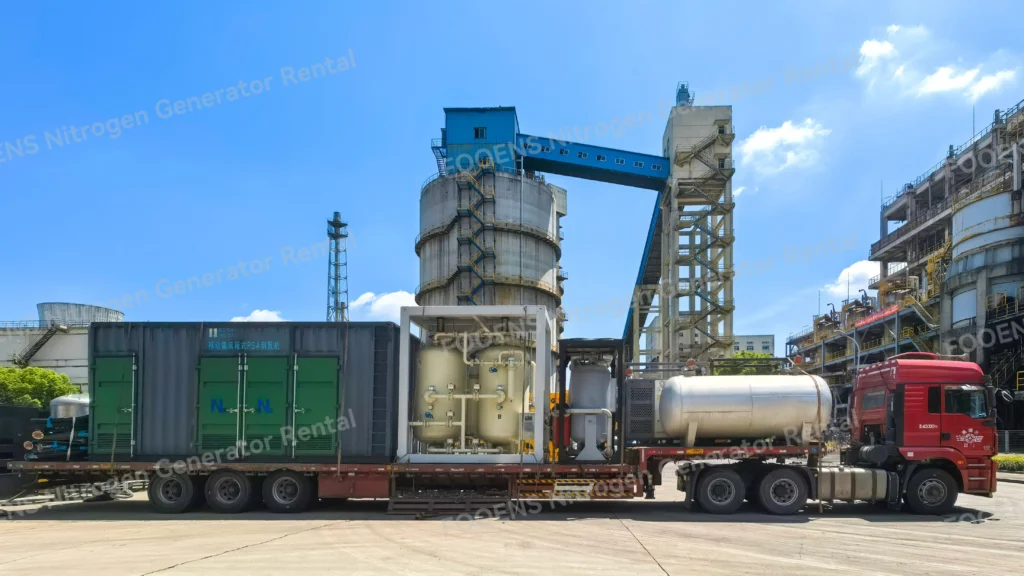
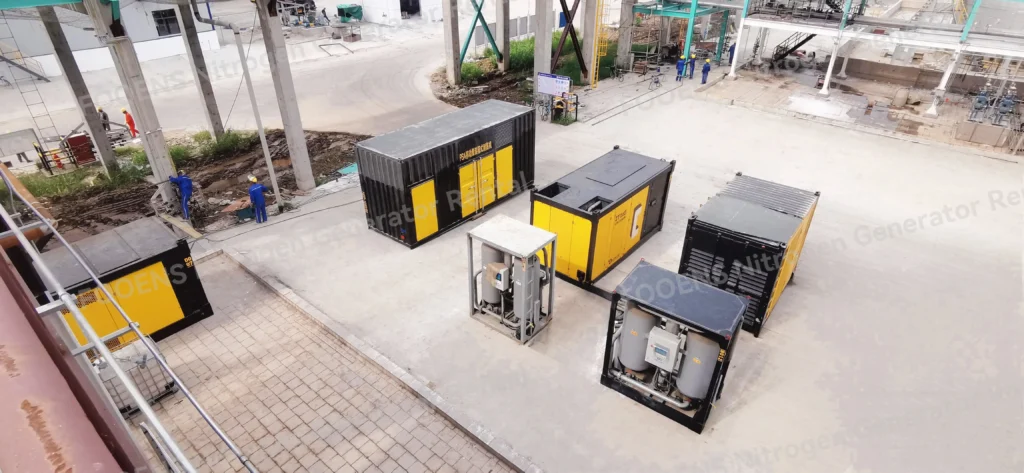
Thus, the key to building a stable system lies not in the performance of a single unit, but in a continuous, stable, and redundant nitrogen supply capacity. This is why more and more enterprises are turning to FOOENS nitrogen generator rental services:
Flexible Technological Matching: Equipment options cover both membrane separation and PSA (pressure swing adsorption) technologies, configurable according to purity and flow requirements.
System Design for Fluctuation Control: Equipped with buffer tanks and intelligent control systems for automatic pressure adjustment, minimizing fluctuation impact.
Redundancy for Continuous Supply: Supports “main unit + backup unit” configurations, with quick on-site installation, ready-to-use setup, and no upfront capital investment.
For any process relying on inert gas protection, in many cases, it is more effective to build a flexible nitrogen supply system responsive to demand changes than to simply purchase standalone equipment. This is why the FOOENS RENTAL service demonstrates superior flexibility and practicality in specific applications.
Conclusion: From “Parameter Compliance” to “System Reliability”
The core goal of inert gas protection is to provide a stable safety boundary for production or storage processes. Achieving this goal has evolved from the traditional focus on a single parameter — purity — toward emphasizing system resilience: the integrated capability to withstand pressure fluctuations and ensure continuous gas supply.
Therefore, when choosing an inert protection solution, enterprises should shift focus from individual equipment performance parameters to a comprehensive assessment of the gas supply system’s interference resistance, scalability, and long-term operational reliability. Only through this approach can the true safety barrier of inert gas protection be effectively established.
ضواغط الهواء الخالية من الزيت التي تعمل بالديزل ES3: الدعم القوي لصناعة البتروكيماويات في هذا المجال الصعب في صناعة البتروكيماويات، يعتبر إمدادات الهواء المضغوط أمرًا بالغ الأهمية. في الأيام الأولى لمشروع البناء الجديد للبتروكيماويات ، كانت المهام معقدة ومترابطة بشكل وثيق. تضمن ES3 إمدادات هواء مضغوط ثابتة من المبنى من خلال نظام التحكم الدقيق في الضغط والتدفق. سواء كان اختبار ضيق الهواء من جهاز رد الفعل الكبير أو عمليات تنظيف الأنابيب ؛ بغض النظر عن مراحل البناء أو الطقس القاسي ، فإن ES3 يوفر الغاز بشكل مستمر ومستقر. عند التفتيش اليومي للصيانة ، تكون مزايا ES3 واضحة. بعد تسوية الموقع يمكن أن تكون في مكانها ، حقن الطاقة بسرعة. إنه خفيف الوزن ومرن ويمكنه العمل بسرعة في جميع أنحاء المصنع ، مما يوفر دعمًا للهواء المضغوط للصيانة. يستخدم ضاغط الهواء ES3 تصميمًا منخفضًا للطاقة ويتم تعديله بذكاء وفقًا لمتطلبات الغاز. يتم تشغيلها وتوقفها تلقائيًا دون إهدار الهواء المضغوط. في مواجهة البيئات البتروكيماوية الخطرة ، يحتوي ES3 على طبقة مزدوجة من مكافحة التسرب ومضاد الشرارة. القضاء على المخاطر ...
As the year turns and a new chapter unfolds, FOOENS extends its warmest New Year greetings to our global customers, partners, and industry colleagues. Happy 2026! Looking back on 2025, our steps were steady and our achievements remarkable. At ADIPEC 2025 in Abu Dhabi , one of the world’s premier energy events, FOOENS showcased its full range of oil-free rental solutions — including oil-free air compressors , nitrogen generators , and boosters. With the advantages of high purity, stable performance, and energy efficiency , our solutions earned widespread recognition from customers across the Middle East , Europe, Southeast Asia, and beyond. Supported by our expanding logistics and service network in Central Asia , the Middle East, and Southeast Asia , FOOENS remains committed to the values of simplicity, efficiency, pragmatism, and innovation . We continue to deliver rapidly deployable, ISO-certified clean gas systems to industries such as petrochemi...
In industries such as chemicals, electronics, food processing, and metal fabrication, nitrogen is an essential utility for many production processes. When facing temporary nitrogen demand, maintenance shutdowns, new project commissioning, or short-term capacity expansion, companies typically consider three options: liquid nitrogen supply , purchasing a nitrogen generator, or renting a nitrogen generation system. Liquid nitrogen offers quick deployment and immediate availability, but ongoing refill, transportation, and storage costs need to be considered. Purchasing equipment is suitable for long-term, stable nitrogen demand, yet requires higher upfront investment as well as maintenance and management. Nitrogen generator rental, on the other hand, is often the better fit for temporary, project-based, or fluctuating demand. So, when comparing these three options, which one delivers better cost efficiency, reliability, and suitability for on-site operations? FOOENS is a specialized compre...

.png)


评论
发表评论